

Journal article in Sustainability
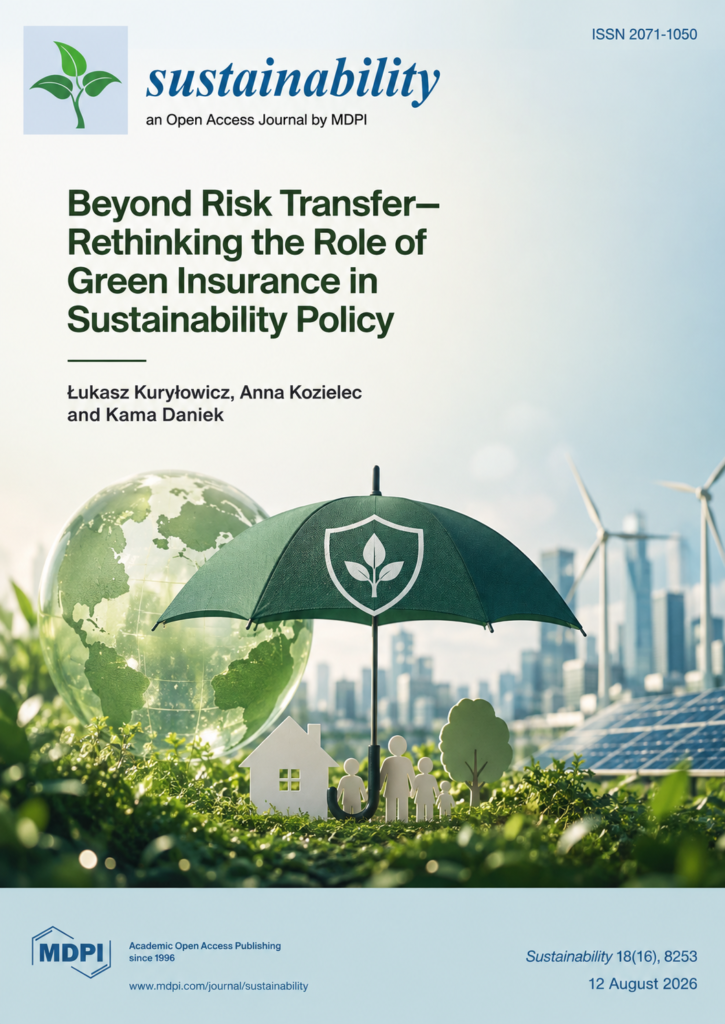
Insurance is traditionally understood as a mechanism for transferring the financial consequences of risk. But can it also contribute to changing the underlying environmental risk itself?
The article “Beyond Risk Transfer—Rethinking the Role of Green Insurance in Sustainability Policy” explores this question by reconsidering the role that insurance may play in supporting environmental and sustainability objectives.
At the centre of the analysis is the concept of risk transformation. It describes situations in which insurance-related mechanisms contribute to sustained and independently verifiable reductions in environmental risk or its underlying drivers. This goes beyond compensating for losses or reducing the exposure of an insurer’s portfolio.
The proposed framework identifies four pathways through which such transformation may occur:
- economic – through pricing, underwriting and capital allocation;
- behavioural – by creating incentives for prevention and adaptation;
- informational – through risk assessment, monitoring and verification;
- institutional – by influencing standards, practices and environmental governance.
An important implication is that “green insurance” should not automatically be equated with environmentally beneficial insurance. A product may carry a green label while doing little to alter the underlying risk. Insurance may transfer losses, improve loss prevention or change portfolio composition without necessarily producing a lasting environmental effect.
This leads to a more demanding question for both research and sustainability policy: rather than asking simply whether an insurance product is “green”, we should ask whether, how and under what conditions it produces a measurable and persistent transformation of environmental risk.
The framework therefore provides a basis for moving the discussion beyond labels and intentions towards the empirical evaluation of the actual environmental effects of insurance.
Abstract
Environmental risks associated with climate change, biodiversity loss, and sustainability transitions extend beyond the allocation of financial losses. Research recognises insurance’s role in environmental risk management and sustainable finance. It also considers climate adaptation and governance, but remains fragmented across disciplines and analytical levels. This study develops an integrative conceptual framework distinguishing risk transfer, established insurance incentive and portfolio effects, and risk transformation. Drawing on a theory-informed synthesis of the literature, it connects insights from environmental economics and principal–agent theory. Signalling and institutional theory provide complementary perspectives. Risk transformation is defined as an outcome in which insurance-related mechanisms make a demonstrable contribution to sustained and independently verifiable reductions in underlying environmental risk or its alterable drivers. Such transformation may occur within a single insured organisation; cross-level transmission may broaden or amplify its effects but is not a defining condition. The framework identifies four potential economic, behavioural, informational, and institutional pathways, which may operate separately or jointly, with capital allocation incorporated into the economic pathway. A context-specific operational protocol specifies ex ante magnitude, persistence, attribution, and verification criteria without imposing a universal scale across heterogeneous risks. The framework also identifies pathway complementarity, conflict, and single-path failure and specifies the boundary conditions that determine whether the pathways generate substantive risk reduction. It explains when effects remain confined to compensation, conventional incentives, insured-loss reduction, risk selection, portfolio de-risking, or symbolic compliance. The study concludes by formulating categorised research propositions and corresponding empirical strategies.
Keywords:
green insurance, risk transformation, sustainability transitions, sustainable
finance, environmental governance
JEL Classification:
G22, Q56, Q58
Credits
| Authors | Łukasz Kuryłowicz, Anna Kozielec, Kama Daniek |
| Date | 2026 |
| Pages | 1-35 |
| Type | Journal article |
| ISSN | 0137-7264 |
| DOI | 10.3390/su18168253 |
| How to cite | Kurylowicz L., Kozielec A, Daniek K. (2026). Beyond Risk Transfer—Rethinking the Role of Green Insurance in Sustainability Policyes, and Challenges. Sustainability, 18, 825, pp. 1-35. |
Full text
Full text is available at ResearchGate